
A fiber crew is waiting on conduit access, the radio contractor is asking for a turn-up window, and the data-center fit-out team still doesn't have final rack delivery dates. Meanwhile, someone is trying to reconcile permits, shipping updates, and test records in three different spreadsheets. That's where telecom logistics planning gets real, not as a theory, but as the difference between a clean handoff and a month of rework.
The best telecom programs treat logistics planning as a network discipline, not a shipping task. That matters because the field has evolved from manual movement of materiel into a business function built on data, software, and network design, with the global logistics market valued at about $9.41 trillion in 2023 and $9.97 trillion in 2024, and projected to reach $21.91 trillion by 2033 (Redalyc). In telecom, that scale shows up in smaller ways every day, with route surveys, make-ready work, tower access, staging, and as-built closeout all depending on each other.
Understanding Telecom Logistics Planning
Telecom projects expose weak planning fast. A route looks clear on paper, then a utility owner needs make-ready work, a municipality wants a different permit packet, or a tower crew arrives before the hardware is staged. The result is usually the same, crews wait, costs creep, and someone starts firefighting.
Why telecom logistics planning is different
Generic logistics advice focuses on moving boxes efficiently. Telecom logistics planning has to move materials, crews, approvals, and test evidence in the same sequence. Fiber builds need corridor access and splice readiness. Wireless work needs lift plans, site windows, and coordination with landlords or tower owners. Data-center fit-outs need tight control over racks, power, structured cabling, and turnover documentation.
A practical starting point is to build the plan around the network outcome, then work back through the route or site list, bottlenecks, transport, and staging. That sequencing matches the baseline-audit approach recommended for stronger logistics programs, where planners define service targets, map volumes and capacities, and track delivery accuracy and on-time performance (Unleashed Software).
Practical rule: if the permit isn't ready, the material isn't ready, and the crew isn't ready, the project isn't ready.
That sounds obvious, but it is easy to miss when teams manage each workstream separately. A simple way to keep the plan coherent is to tie dispatch, site access, and vehicle status into one operating view, especially when crews cover multiple counties or metro zones. Tools such as Rally's fleet management platform can help teams coordinate movement and availability when project vehicles are part of the delivery chain.
What good planning protects
Good telecom logistics planning protects three things at once, schedule, quality, and SLA performance. It keeps teams from celebrating “materials ordered” before the key question is whether those materials will arrive where the crew can use them. It also prevents closeout from becoming a scramble, because field delivery depends on the right evidence being captured along the way, including as-builts, test results, and handoff records.
The discipline changed for a reason. Logistics moved from military-style procurement and transport into business planning as computerization, personal computers, and ERP systems made enterprise coordination possible (Redalyc). Telecom is where that shift matters most, because each build has enough moving parts to punish any gap between design, field access, and execution. Planning well means the route survey, permitting path, staging plan, and reverse logistics flow all line up before the first truck rolls.
The same idea extends beyond the jobsite. For field teams that need to coordinate vehicles, access windows, and crew movement across a build area, site mobility coordination can be as important as freight handling, because the wrong truck at the wrong gate delays the whole shift.
Integrating Pre-Project Surveys and Permitting
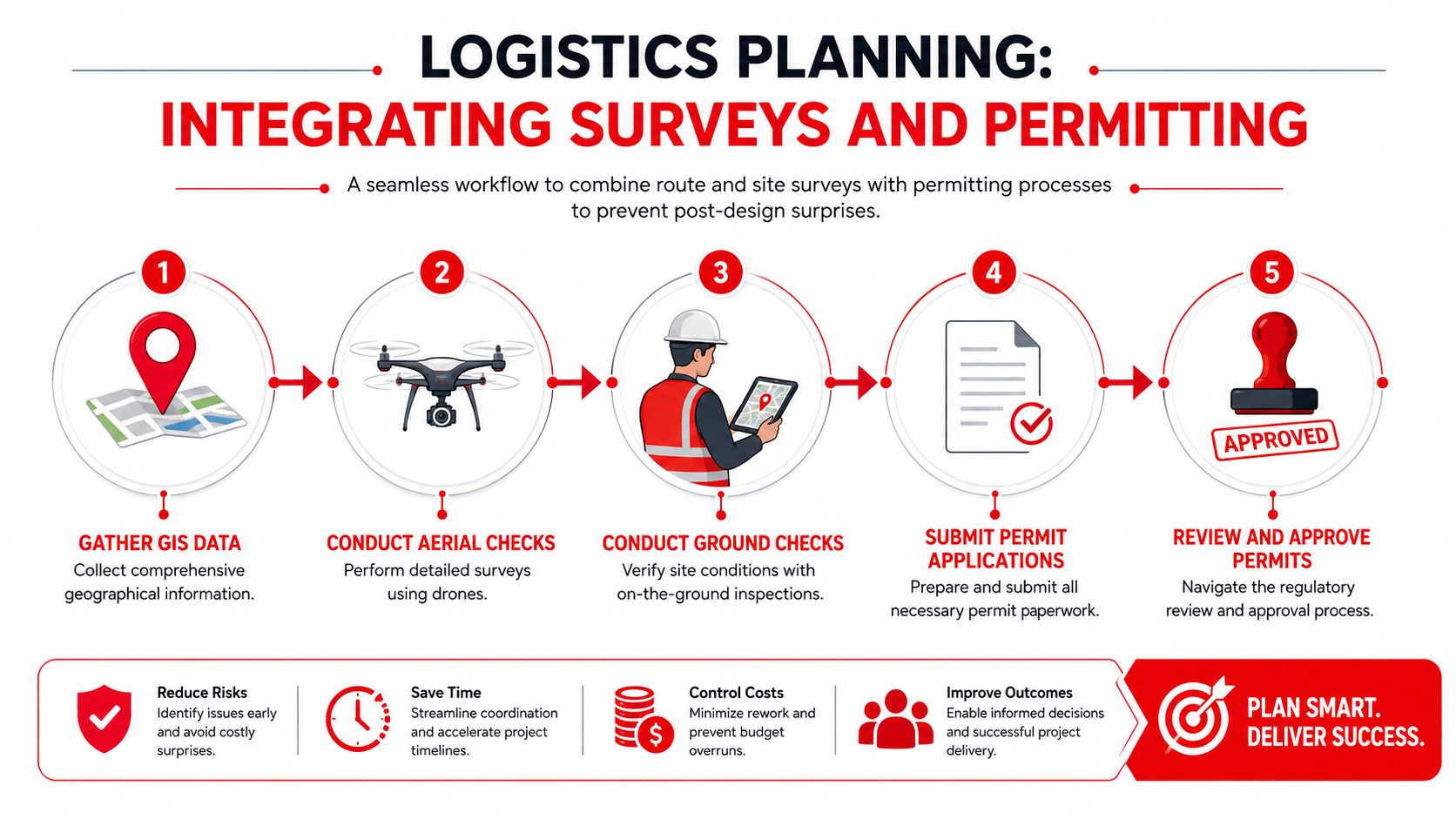
A telecom build starts slipping the moment survey work and permitting are treated as separate tracks. A route survey may look clean in GIS, then the field team finds a utility conflict, a drainage constraint, or a right-of-way issue that never made it into the permit packet. That is a planning failure, not a paperwork problem.
Build the route record before anyone fills out forms
Start with GIS data, but do not stop at a map layer. Pull parcel boundaries, road classes, utility corridors, easements, and known access constraints into one working file. Then compare that desktop view with aerial checks and ground checks so the record captures what is on site, and not only what the base map suggests.
For fiber corridors, field crews should log poles, handholes, cabinets, pedestals, signs of congestion, and visible utility attachments. For wireless sites, note access roads, gate restrictions, compound layout, crane or lift requirements, and anything that affects equipment staging. In data-center work, the same discipline helps with loading access, rack routes, and any restriction that slows inbound material. The goal is a survey output that permitting can use without a second round of interpretation.
Survey notes should answer one question clearly, what will stop the crew from working on day one?
Translate field findings into permit requirements
Once the route record is solid, map each finding to the permit type or approval it affects. Road openings, lane closures, right-of-way permissions, utility attachment approvals, and make-ready work all belong in the same tracker. If a survey shows a utility conflict, the permit packet should identify who owns the clearance step and what evidence proves it is resolved.
A practical checklist keeps the handoff tight:
- Confirm route scope early: Lock the build corridor, site boundary, and access points before paperwork starts.
- Document field evidence: Attach photos, sketches, and location notes from aerial and ground checks.
- List every approval dependency: Include road opening, utility, landlord, and right-of-way items in one register.
- Assign ownership: Name who submits, who follows up, and who escalates each permit.
- Track make-ready separately: Utility work often runs beyond the original survey timeline, so do not bury it inside general permit status.
European planning guidance treats logistics as a cross-department process that has to define scope, stakeholders, and coordination structures, which fits telecom work well because permits are rarely owned by just one team. The World Bank's urban logistics resilience guidance also pushes planners to ask whether prior disasters changed system design and whether budgets exist for continuity simulations (World Bank). That thinking belongs in telecom surveys too, because the build cannot be separated from the approvals that make it legal to work.
For a practical field lens on stakeholder coordination, local community engagement tactics matter more than many planners expect, especially when work crosses municipal boundaries or neighborhood access points. A useful reference is community engagement strategies, because public-facing communication often determines how quickly site access issues get resolved.
Do not let the permit packet become a dead end
Many teams treat permitting as a finish line. That approach creates avoidable churn. A permit works better as a live control file that gets revised when utility owners, road authorities, or site hosts add conditions. It should feed mobilization dates, crew routing, and material staging.
That control file also needs to stay tied to field reality. When a site changes, the record should reflect the on-the-ground situation, and it should supplement what the base map showed at the start. For teams that coordinate vehicles and crew movement across the build area, Mobile Systems Limited's fleet solutions can support routing and availability tracking, especially where access windows are tight and vehicle timing affects the whole shift.
A brief video briefing can also help field and office teams stay aligned before the first notice is filed.
The operating logic should stay simple. Survey, verify, map dependencies, submit, then update the plan when the approvals change. Anyone who has watched a clean design stall because a utility sign-off lagged behind the route package already knows why that sequence matters.
Consolidating Procurement Materials and Crew Scheduling
The most expensive procurement mistake in telecom logistics planning isn't buying too much. It's buying at the wrong time. A crew shows up ready to splice, mount, or rack, and the wrong pallet is on site, or the right pallet is stuck in transit while the team burns time and morale.
Match lead times to the crew calendar
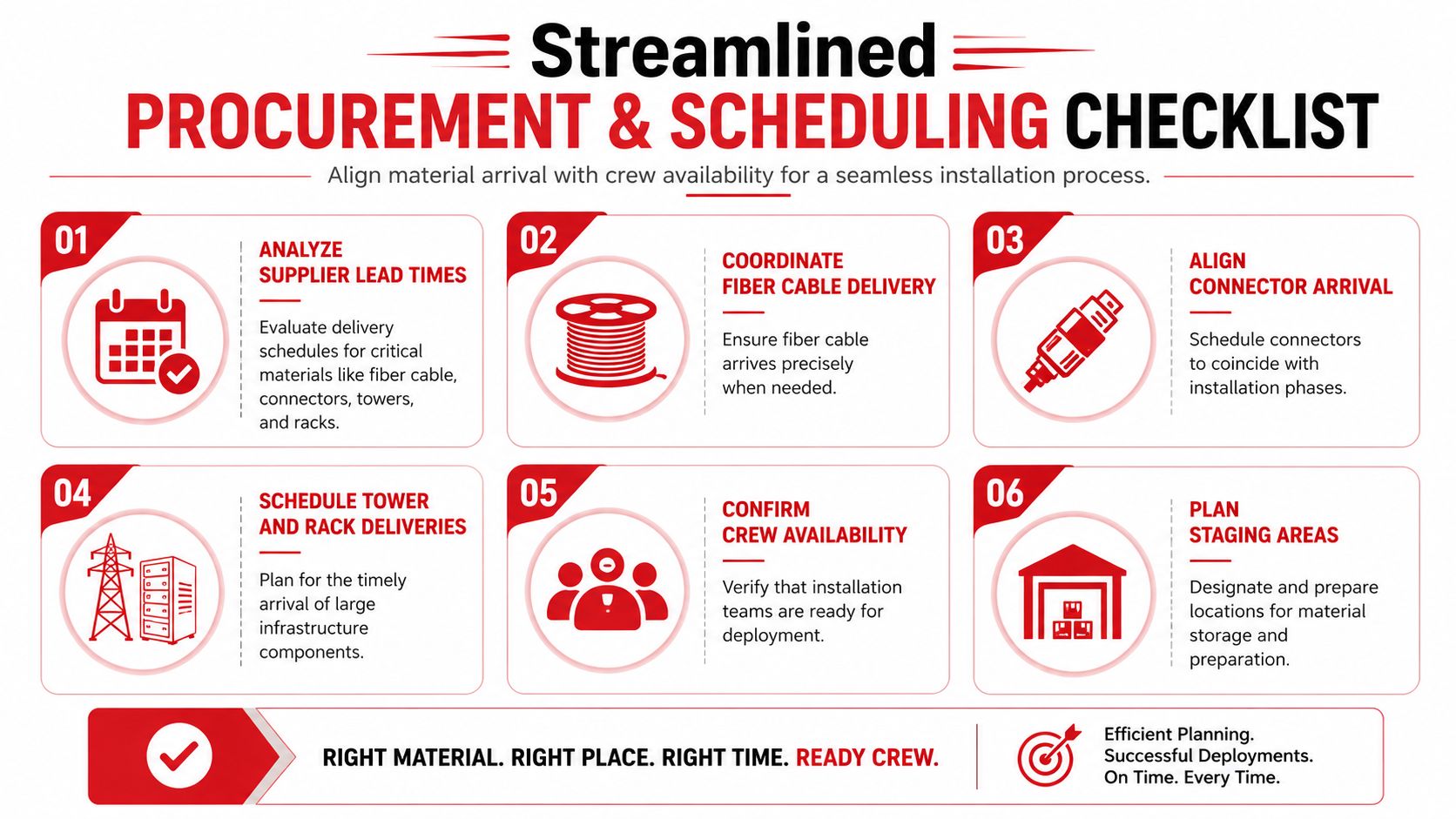
Start with lead-time analysis for the items that can stop work, fiber cable, connectors, towers, racks, and any specialty hardware that isn't easy to substitute. Then build the crew calendar beside it, not after it. Splicers, tower climbers, and data-center installers all have different readiness windows, and the schedule needs to reflect that reality.
A staging plan works best when it separates long-lead, short-lead, and day-of-use items. Long-lead items need firm release dates and transport visibility. Short-lead items need a tighter arrival window. Day-of-use consumables need local staging and quick replenishment so crews don't pause over small shortages.
A crew waiting on one missing component often costs more than the component itself.
The financial pressure is real. Global inventory holding cost is estimated at $1.7 trillion annually, equal to 24% of total inventory value (WorldMetrics). In telecom, that's the warning sign that overbuying or misplacing stock is not just inefficient, it's capital sitting idle while project risk keeps moving.
Use a staging sequence that mirrors the workface
The cleanest method is to stage by build segment. For example, if one splice team is working from handhole A to cabinet B, the hardware, reels, labels, and test gear for that segment should be bundled together. If a wireless crew is preparing a rooftop or tower site, the mounts, radios, grounding, and installation consumables should be issued as one pack, not pulled from random stock.
A sample rhythm helps:
- Confirm release dates for materials that can affect the critical path.
- Freeze the crew roster for the field window that matters.
- Stage by workfront, not by warehouse convenience.
- Hold a buffer for carrier delays, weather, and access changes.
- Update dispatch daily so the field doesn't work from stale assumptions.
For fleet-enabled teams, vehicle visibility can be the difference between a controlled shift and a wasted day. A useful reference for that operational layer is vehicle-mounted communications and fleet telematics, because real-time updates help crews adjust when shipments slip or access windows move.
Keep the warehouse honest
Cross-dock staging areas help only when they're disciplined. Materials should enter, be checked, and move out with clear labels tied to site, segment, and crew. If you can't tell which pallet belongs to which build window without opening the wrapping, the staging process is too loose.
The internal lesson from telecom procurement is simple. The warehouse doesn't win by filling space. It wins by feeding the crew with the right sequence at the right time. For supplier selection and carrier coordination work, cable contractor companies is a useful starting point when you're comparing how different vendors support field execution.
Streamlining Equipment Deployment and Testing Workflows
Field teams often lose time between installation and testing because nobody owns the handoff. One crew finishes the physical work, another crew arrives later, and test gear sits in a truck while everyone waits for a clear path through the site. In telecom, that gap is where quality gets diluted.
Keep installation and test readiness together
The cleanest workflow starts before equipment leaves the yard. Fiber panels, radios, racks, and termination kits should be labeled, protected, and grouped by link or site segment. That sounds basic, but it avoids the common failure where the installer completes the job and the tester has to rebuild the context from scratch.
Splice crews should be assigned to specific segments with the test plan already attached. OTDR testing, power-on checks, and signal verification work best when they happen in one continuous sequence, because the person who sees the first anomaly can often trace it faster than someone who only receives the report later. The same discipline helps on data-center jobs, where power-path checks and equipment placement need to line up with the as-built record immediately.
Protect the handoff from condition loss
Reverse logistics is the blind spot many teams ignore. FLEX points out that returns and condition monitoring often stay opaque even though they represent meaningful volume and cost, and that ignoring condition data can make operations look fine while product integrity is still failing (FLEX Logistics). That applies directly to telecom because equipment can arrive on time and still be compromised by handling, moisture, or incomplete transit checks.
The practical fix is to log condition at handoff, not only at delivery. If a pallet or case changes custody, the receiving team should confirm packaging condition, label integrity, and visible damage before installation starts. That matters even more on carrier turn-ups and data-center fit-outs, where a hidden fault can trigger rework after the site is already live.
For fiber-specific verification practices, how to test fiber optic cable is a useful technical reference when crews need a reminder of how test evidence should support the field record.
Build a single route from install to closeout
A lot of teams still work in compartments. Install, then test, then document. That sequence creates delays and makes ownership fuzzy. A better method is to treat the install as the first half of closeout, with labels, photos, splice logs, and test traces captured as the work advances.
A short field rule helps here:
- Label as you place: Every component should be identifiable before the crew moves on.
- Bundle by segment: Keep parts for one link or room together.
- Test before release: Don't hand off a segment until the evidence is saved.
- Record exceptions immediately: Anything damaged or missing should be captured at once.
- Close the loop with as-builts: If the drawing doesn't match the field, it isn't done.
That's how you prevent the common telecom trap of green transit status and red field quality. The shipment may have arrived on schedule, but if the handoff wasn't controlled, the job still slips.
Embedding Risk Management Safety and Contingency
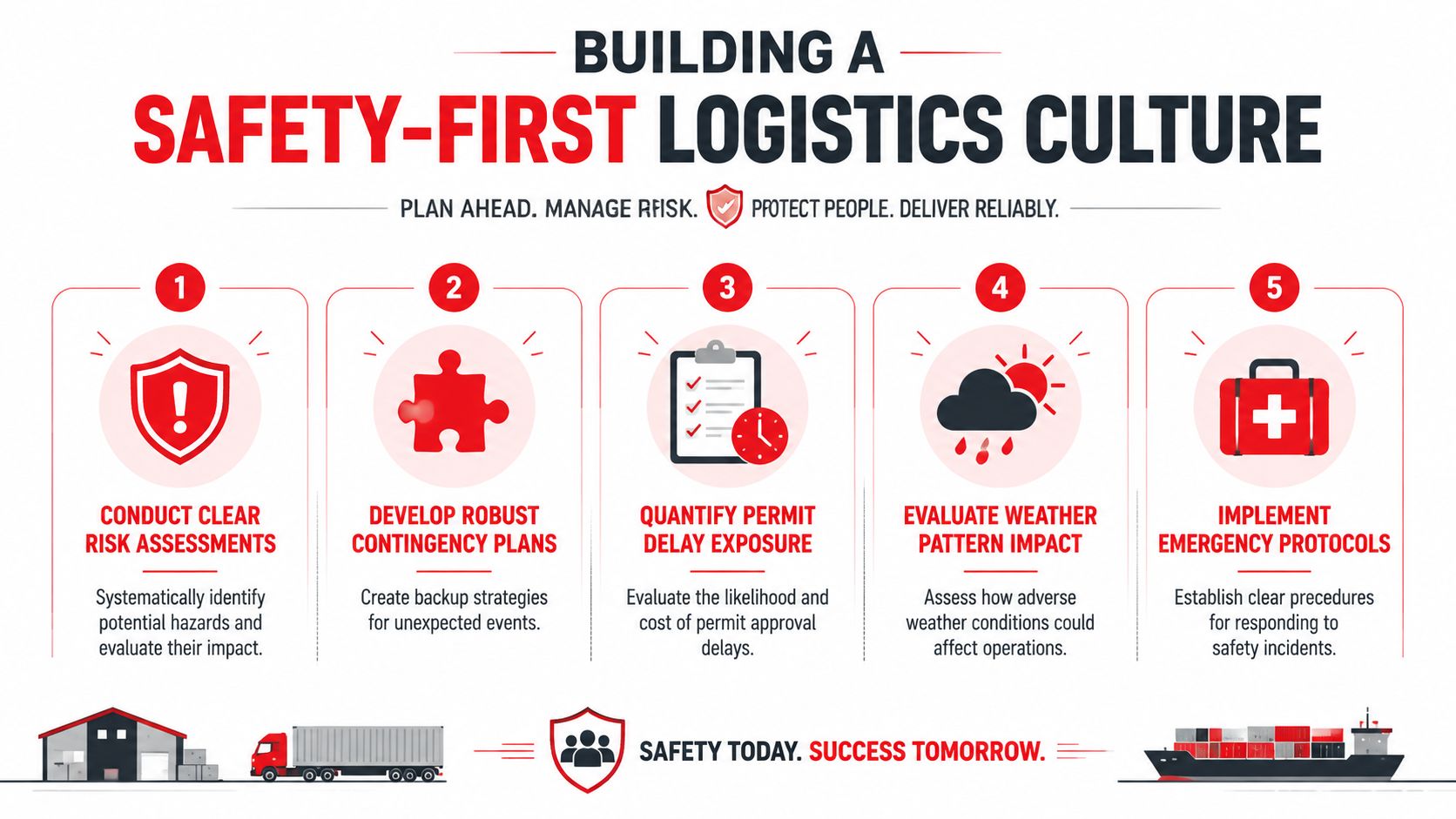
A telecom build is tested hardest when access changes, weather turns, or approvals stall. The projects that keep moving are the ones that have already mapped where failure is most likely and who steps in when it happens. Safety and contingency planning belong in the logistics file from the start, rather than waiting for the first incident.
Quantify the disruptions you can name
Start with the risks that already show up in the field. Permit delays, weather for aerial builds, utility coordination bottlenecks, site access restrictions, and shared-space conflicts are all measurable because they recur and leave a paper trail. The World Bank's resilience guidance asks planners to look at past disasters, judge whether the impact was concentrated, and decide whether continuity drills are funded, which matches the way telecom crews have to plan for exposed routes and hard-to-reach sites (World Bank).
A contingency plan only works when the trigger and the owner are both named. If a permit slips, who calls the agency? If a storm stops aerial work, who re-sequences the crew? If a utility move blocks the route, who updates the construction window?
If nobody owns the escalation, the escalation doesn't exist.
Run drills before the project forces the lesson
Teams should rehearse disruption, not just talk through it. A practical exercise is to simulate a no-access day, a delayed shipment, or a last-minute utility conflict and have the team update the plan in real time. The point is not punishment, it is to expose where the communication chain breaks.
Keep the safety side equally practical. Use a checklist that covers site entry, lift setup, traffic control, PPE, emergency contacts, and stop-work authority. Those items should sit beside the day's work order so supervisors use them.
A useful emergency map should show three levels of response, field lead, project manager, and external stakeholder. If a tower or aerial site becomes unsafe, the crew needs to know who can halt work, who informs the client, and who resets the schedule. The same structure helps when a fiber route is blocked, because the next action is usually coordination, not improvisation.
Budget for continuity instead of hoping for smooth weeks
A resilient logistics plan accepts that some days will go off plan. The budget should leave room for rechecks, re-routing, re-entry, and extra coordination meetings when the work site changes. That does not mean padding everything. It means recognizing that telecom rollouts depend on public agencies, private property owners, utilities, and subcontractors, and each of those parties can shift the timeline.
Safety-first logistics is not a soft concept. It is the operating method that keeps one delay from turning into a chain reaction.
Capturing Documentation Handover and KPIs
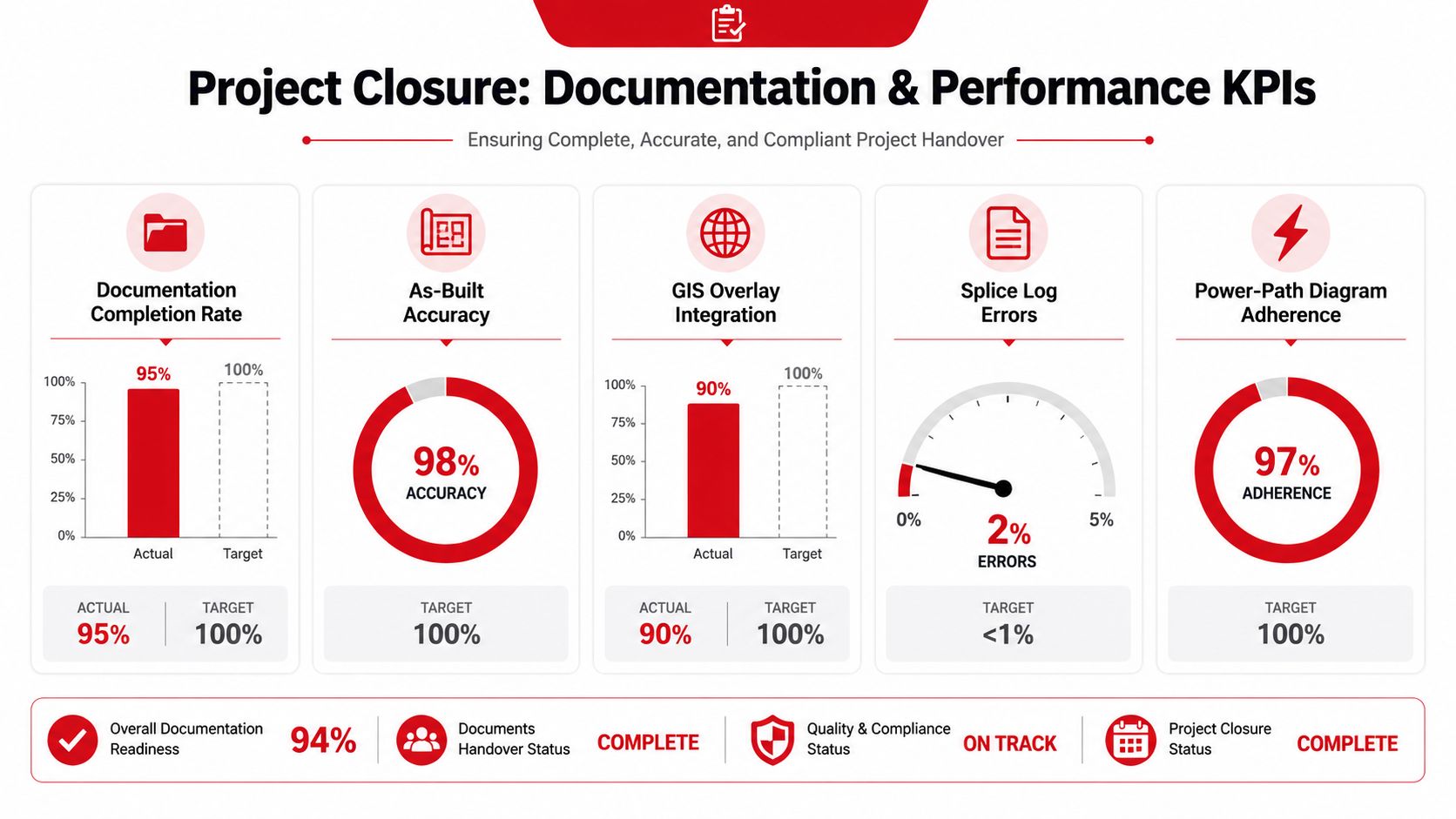
Closeout is where many telecom projects lose credibility. The site may be physically complete, yet the client still needs as-builts, splice logs, power-path diagrams, GIS overlays, and a clean handoff record. If that package lands late or arrives incomplete, the build is finished in the field but still unresolved in commercial terms.
Make documentation part of the work flow
The strongest closeout packages start during execution. Every crew needs to know which files matter, how they are named, and where they are stored. GIS overlays should match the build corridor or site layout. Splice logs should show the completed path clearly. Power-path diagrams must reflect the final installation, which may differ from the original drawing.
A baseline-audit mindset still helps here. Strong logistics planning begins with a baseline and turns it into a KPI-driven design, where teams define service targets, map volumes and capacities, identify bottlenecks, and track delivery accuracy, on-time performance, transport cost, and customer satisfaction (Unleashed Software). In telecom, that same discipline shows up in documentation readiness, as-built accuracy, closeout timeliness, and technical compliance.
Use a small set of closure metrics
Too many dashboards blur accountability. A better one stays simple and visible. For closeout, the most useful measures are the ones that answer whether the client can accept the work without extra chasing.
A practical dashboard might track:
- Documentation completion: Are all required files submitted?
- As-built accuracy: Do the records reflect the field conditions?
- GIS integration: Are the map layers tied to the final route or site?
- Splice log quality: Are the records readable and consistent?
- Power-path adherence: Does the final diagram match the installed path?
The point is to make it obvious where a package is incomplete and who needs to fix it. When a crew knows the dashboard will be reviewed at closeout, the handoff gets tighter long before the final packet is due. In fiber, wireless, and data-center work, that visibility also reduces rework during acceptance reviews, because the missing pieces show up while the field team is still available.
Good KPIs don't just report status, they change behavior while the job is still active.
Feed lessons back into the next build
A closeout package should end with a short lessons-learned note. Which permit step delayed mobilization? Which carrier process slowed equipment handoff? Which test record caused rework? Those answers belong in the next project's baseline, not buried in a file archive.
The strongest teams use documentation as input for the next estimate, the next staging plan, and the next crew schedule. That is how telecom logistics planning becomes a repeatable system instead of a series of one-off recoveries. It also helps reverse logistics, since returned material, removed hardware, and excess stock need the same traceability as new installs.
Conclusion and Next Steps
Telecom logistics planning works when the survey, permit, procurement, staging, installation, testing, safety, and closeout steps all point in the same direction. If one of those pieces runs on a different timeline, the whole project feels it. The practical standard is simple, build the plan around the network outcome, keep the approvals tied to the field record, stage materials against real crew windows, and close every job with documentation that matches what was built.
The teams that do this well usually share the same habits. They keep one control file for dependencies, they review access and permit risks before mobilization, they stage by workfront instead of warehouse convenience, and they treat testing and handoff quality as part of the build, not separate chores. They also keep contingency planning alive, because telecom sites don't fail politely and delays rarely stay isolated.
Start with one pilot project and tighten the workflow there. Use the survey-to-permit path, the procurement-to-crew calendar, and the closeout dashboard as your baseline. Then capture the lessons while the details are still fresh, because the next rollout will be faster only if the current one leaves behind a better system.
Southern Tier Resources supports fiber, wireless, and data-center teams that need disciplined logistics planning from permitting through closeout. If you're refining your rollout playbook or trying to reduce handoff gaps on the next build, visit Southern Tier Resources to see how their field, testing, and documentation capabilities fit into a tighter delivery process.