You arrive at a wireless site before sunrise. The tower looks sound from the access road, but the base plate has exposed steel, a grounding connection shows signs of deterioration, and salty air has worked into a coating seam. Nothing is dramatic yet. The risk is quiet, and that's exactly why corrosion technician jobs matter.
Corrosion control isn't limited to refineries and long-distance pipelines. Tower owners, wireless carriers, neutral hosts, utilities, and telecom contractors also need people who can verify that steel, grounding paths, coatings, and related protective systems are performing as intended. A technician's measurements can influence whether a site receives a routine maintenance order, a coating repair, a grounding correction, or a more urgent engineering review.
This guide starts with the fundamentals, then moves into field duties, credentials, standards, compensation, applications, and long-term career development. The central lesson is clear: a corrosion technician doesn't just look for rust. They collect defensible evidence about asset condition and help keep infrastructure safe, compliant, and available.
Introduction to Corrosion Technician Jobs in Telecom
Telecom infrastructure creates a different working context from the pipeline environments commonly associated with corrosion control. A technician may inspect a monopole near a coastal road, a guyed tower beside an agricultural field, a small cell cabinet in a wet urban corridor, or a grounding network shared with electrical equipment. Each location exposes metal and connections to different combinations of moisture, salts, pollutants, soil conditions, dissimilar metals, and mechanical stress.
The visible tower is only part of the system. A coating defect at the base can let moisture reach structural steel. A deteriorated bond can change how current moves through a grounding or protective network. A loose or damaged connection can make a drawing appear correct while the field condition tells a different story. The technician's job is to identify those differences before they become expensive repairs or safety concerns.
Corrosion technician work has a recognized professional foundation. The organization now known as AMPP traces its history to 1943, when 11 corrosion engineers founded NACE. Its cathodic protection pathway later expanded through an accreditation program in 1971, a cathodic-protection recognition program in 1987, and a training and certification program by 2000. Since 2004, the pathway has been structured around CP Tester, CP Technician, CP Technologist, and CP Specialist levels, as documented in the AMPP history of NACE.
That background matters to a telecom candidate because it shows that the occupation isn't an improvised field assignment. It's a credentialed trade built around repeatable measurements, technical judgment, records, and standards.
What this guide will help you decide
You'll learn how to:
- Understand the work: Separate visual inspection from electrochemical testing and condition assessment.
- Translate skills to telecom: Connect corrosion control to tower steel, grounding, cabinets, small cells, and site power.
- Read the hiring signal: Recognize why employers value CP credentials, coatings knowledge, documentation, and code familiarity.
- Set pay expectations: Interpret broad compensation bands without assuming one national rate applies to every role.
- Apply with evidence: Present field experience in language that tower companies and contractors can evaluate quickly.
A new technician doesn't need to know every standard on the first day. They do need curiosity, disciplined note-taking, safe work habits, and the willingness to treat every reading as evidence rather than confirmation of what they hoped to find.
What a Corrosion Technician Does and Why It Matters
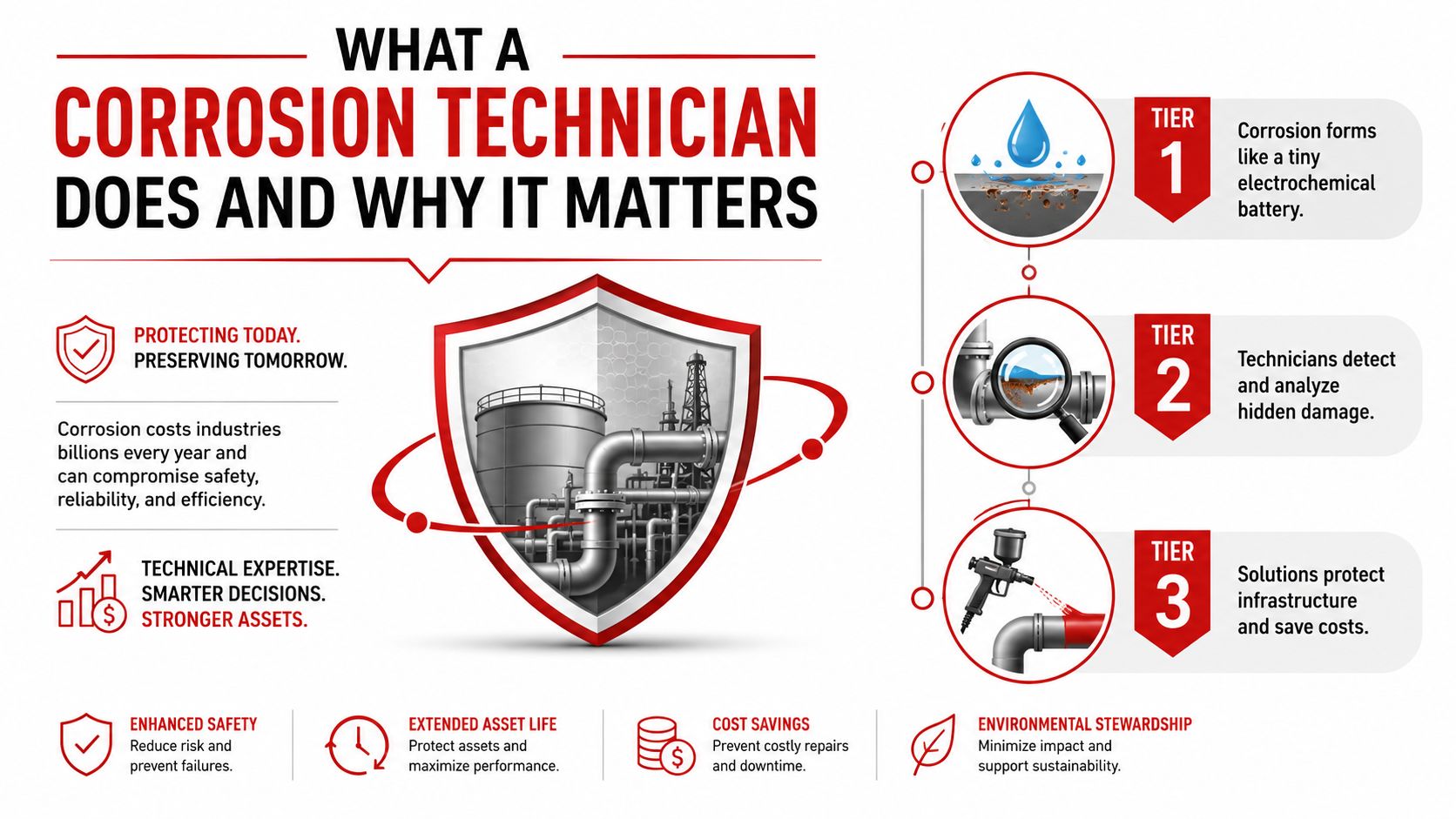
Corrosion begins when an environment allows metal to participate in an electrochemical reaction. A useful field analogy is a small battery spread across a metal surface. Moisture and contaminants help create pathways, different areas of the metal behave differently, and material is gradually consumed at the active areas.
Rust is the obvious example, but corrosion control covers more than orange discoloration. A galvanized member can lose protection. A painted base can blister or underfilm corrosion can spread beneath an apparently intact coating. A grounding connection can deteriorate at a point that's hard to see. On telecom sites, those conditions may affect tower members, anchor hardware, cabinet supports, fence components, buried conductors, and connections between systems.
Technicians use two broad protective strategies:
- Coatings create a barrier. Paint, galvanizing, and other systems separate metal from the environment. The technician checks coverage, damage, adhesion-related concerns, weathering, and repair quality.
- Cathodic protection manages the electrochemical reaction. The system supplies protective current or uses sacrificial material so the asset becomes less likely to dissolve. The technician verifies performance with instruments and records.
The technician is the verification point
A corrosion technician doesn't accept appearance as proof. Clean steel may have a hidden condition, while a stained surface may not represent structural damage. The technician gathers readings, checks connections, compares results with required criteria, identifies anomalies, and documents what should happen next.
Field rule: If a protective system can be measured, measure it. If a condition can change the decision, document it.
On a telecom site, that may mean checking a tower base and its coating, tracing grounding and bonding connections, inspecting a cabinet environment, or evaluating exposed hardware near a small cell installation. The exact test depends on the asset and the governing procedure, but the reasoning stays consistent: identify the exposure, verify the protection, record the condition, and escalate findings that need engineering or maintenance action.
The profession's structured pathway reinforces that approach. The four-level CP progression described by AMPP's NACE history gives employers a way to distinguish basic testing capability from broader technical interpretation and specialist responsibility. For a job seeker, it provides a career map. For a hiring manager, it provides a framework for assigning work safely.
Daily Duties and Field Work on Telecom Infrastructure
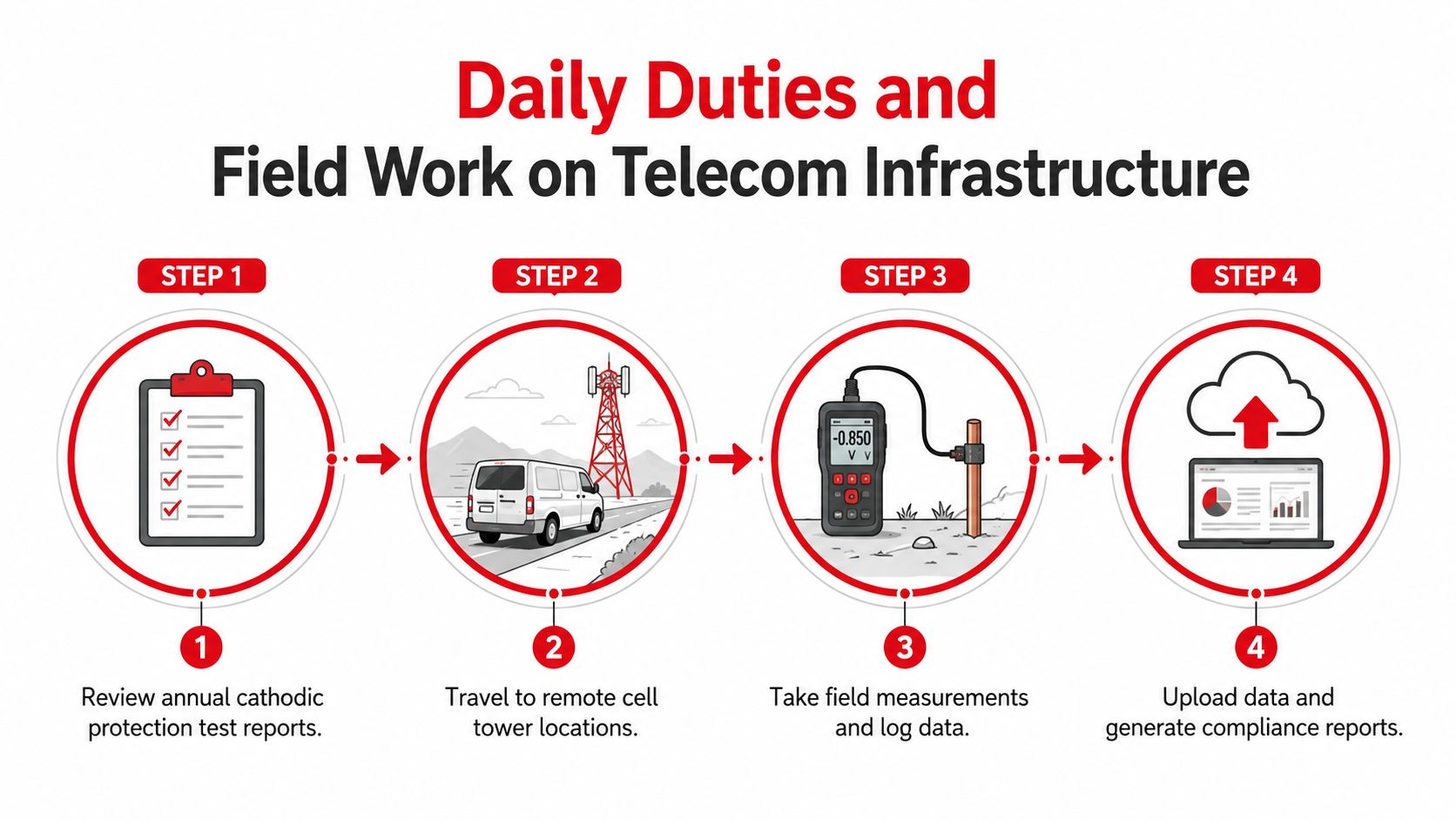
A tower site may look routine on arrival, yet the day's result depends on preparation. Before testing, the technician reviews earlier readings, site drawings, access instructions, equipment needs, and unresolved corrective actions. At a remote tower, leaving behind a cable, reference electrode, meter lead, or safe access plan can turn a short visit into another trip.
Field work joins observation to measurement. A typical corrosion technician posting lists annual cathodic protection surveys, bi-monthly rectifier and critical-bond inspections, stray-current interference testing, coating evaluation, formal test records, and defect assessments. Telecom work may involve a different mix of assets, but the same discipline applies to tower steel, grounding and bonding paths, associated metalwork, and protected equipment.
From site arrival to defensible record
A practical visit usually follows a clear sequence:
- Review the site history: Compare earlier measurements, coating repairs, grounding changes, and unresolved defects.
- Inspect the physical condition: Check tower legs, base plates, guy anchors, exposed fasteners, grounding conductors, cabinets, and cable entry points.
- Test the protective system: Use the specified meter, leads, reference equipment, and procedure to check electrical performance instead of relying on appearance.
- Investigate abnormal results: Look for damaged bonds, interference, poor connections, coating breakdown, or environmental conditions that could explain the reading.
- Create the record: Enter measurements, photographs, locations, weather or site notes, defects, and recommended corrective actions in the required report.
A tower can appear stable while a reading reveals a break in the protective path. A weathered coating may still be serviceable if testing shows that its condition remains within the acceptance criteria. The technician's job is to separate those conditions consistently, so maintenance decisions rest on evidence rather than appearance.
A good report answers three questions: What did you test, what did you find, and what should the owner do next?
Clear reporting matters to carriers and neutral hosts that manage many locations. An engineer can compare sites, a maintenance coordinator can assign work, and an auditor can follow the reasoning behind a decision. Weak notes create repeat visits and uncertainty. Strong notes turn a field visit into an actionable asset record.
The work may include travel, climbing or working at height coordination, traffic and public-interface awareness, weather exposure, and communication with site owners or contractors. Candidates seeking a broader view of infrastructure inspection can review quality transmission and anchorage work to see how careful checking supports reliability across connected assets.
For a visual explanation of field measurement and documentation, use the embedded resource below.
Strong technicians do not rush from an instrument reading to a conclusion. They verify the setup, repeat questionable measurements, note conditions that could affect the result, and communicate uncertainty before maintenance work is chosen.
Skills Certifications and Standards That Employers Require
A tower inspection can reveal rust on a diagonal member, a damaged coating, or a grounding connection that no longer performs as intended. Employers need technicians who can measure the condition, follow the approved procedure, record evidence, and explain when the finding requires escalation. That combination of technical foundation, field readiness, standards awareness, and documentation discipline matters more than collecting certificates without practical skill.
The CP pathway gives candidates a useful progression. A CP Tester concentrates on accurate measurements and repeatable procedures. A CP Technician takes on broader testing and troubleshooting. A CP Technologist or CP Specialist may interpret more complex results, support system decisions, and provide technical leadership. Requirements differ by employer, but this ladder helps you describe your current ability and the next capability you are building.
The standards stack employers recognize
Regulations show why inspection frequency and qualified work matter. Federal U.S. pipeline rules require external corrosion control testing at least once each calendar year, with intervals not exceeding 15 months, under 49 CFR 192.465. An Oklahoma requirement calls for impressed-current CP systems to be inspected every 60 days and requires personnel performing CP testing to meet specified qualifications, including criteria from a nationally recognized code such as NACE SP0285, as described in that regulatory source.
Telecom employers may not apply every pipeline rule to a tower or small cell site. They still expect controlled procedures, acceptance criteria, calibrated instruments, traceable records, and clear escalation. The same habits transfer to tower steel, grounding and bonding networks, cabinets, and wireless assets exposed to weather and contaminants. A technician who understands telecom safety standards can connect corrosion findings with the approved work process without treating a general reference as a substitute for employer training.
Current job-market postings for corrosion monitoring roles frequently list API 510, API 570, API 571, API 580, API 581, and API 653 familiarity as differentiators. Higher-level assignments may also involve risk-based inspection, failure analysis, materials selection, root-cause investigation, positive material identification, and technical documentation. These subjects are useful additions for technicians whose telecom work may connect with broader asset-integrity programs.
Build a hiring profile, not a certificate collection
A practical development plan looks like this:
- Start with measurement accuracy: Learn equipment setup, reference points, test procedures, data integrity, and basic electrical theory.
- Add coating inspection knowledge: Understand surface preparation, coating defects, environmental exposure, and repair documentation.
- Develop troubleshooting judgment: Separate a failed component from a bad connection, interference, poor setup, or misleading field condition.
- Strengthen records: Write concise defect descriptions that another technician can locate and verify.
- Expand into asset integrity: Study code use, risk-based inspection, failure mechanisms, materials, and root-cause analysis as assignments become more complex.
Candidates exploring adjacent industrial apprenticeship pathways may also browse Thales apprentice roles HiredBySkill, particularly when coatings and surface protection form part of their foundation.
Telecom work adds practical site demands. Read site plans, identify grounding and bonding relationships, work around energized equipment under the approved safety process, and explain a finding to a project manager who may not specialize in corrosion. Those skills help carriers and tower companies turn a field observation into a safe, traceable maintenance decision.
Salary Ranges and Job Market Outlook for 2026
A tower steel inspection, a grounding test, and a small cell asset review may all appear under the same job title, yet they can involve different pay bands. A field tester working under close supervision is not taking on the same responsibility as a technician who troubleshoots complex systems, interprets inspection data, supports audits, or applies advanced code knowledge. Carriers and tower companies often price the role around its actual field responsibility, not the title alone.
One 2025 PayScale survey reports an average of $35.64 per hour. Entry-level workers average $24.15 per hour, early-career technicians average $27.21 per hour, and the highest reported pay reaches $51.01 per hour, according to PayScale's corrosion technician hourly-rate data. A separate salary snapshot places the U.S. average at $27.51 per hour, with the $18.75 to $31.25 per hour range covering the 25th to 75th percentiles and top earners reaching $42 per hour, or about $88,000 annually. Another role library estimates an annual range of roughly $58,000 to $90,000, with a median near $74,000.
Corrosion Technician Pay Snapshot Comparison
| Source Type | Average Pay | Entry to Top Range | Key Driver |
|---|---|---|---|
| 2025 pay survey | $35.64 per hour | $24.15 to $51.01 per hour | Experience and certification |
| 2025 salary snapshot | $27.51 per hour | $18.75 to $42 per hour | Location, employer, and role scope |
| Role-library estimate | About $74,000 annually median | Roughly $58,000 to $90,000 annually | Occupation and market mix |
| Job-market postings | Roughly $43,680 to $151,500 annually | Current employer base range of $107,600 to $141,680 | Specialized industry and credentials |
ZipRecruiter's corrosion job listings show the broadest range, from roughly $43,680 at the low end to about $151,500 at the high end. One current employer listing shows a base range of $107,600 to $141,680. These figures do not promise the same pay for a telecom role. They show why title, geography, travel, industrial risk, employer type, and credentials need to be reviewed together.
For a 2026 job search, compare the work package instead of the headline number. Check whether the position includes travel, overtime, emergency response, climbing, report ownership, code interpretation, or responsibility for several asset classes. A lower starting rate may reflect structured training. A higher band may require independent troubleshooting and audit-ready documentation from the first assignment. In telecom, the same distinction can separate routine tower checks from work that protects a carrier's wider network.
How to Apply Interview and Stand Out to Hiring Managers
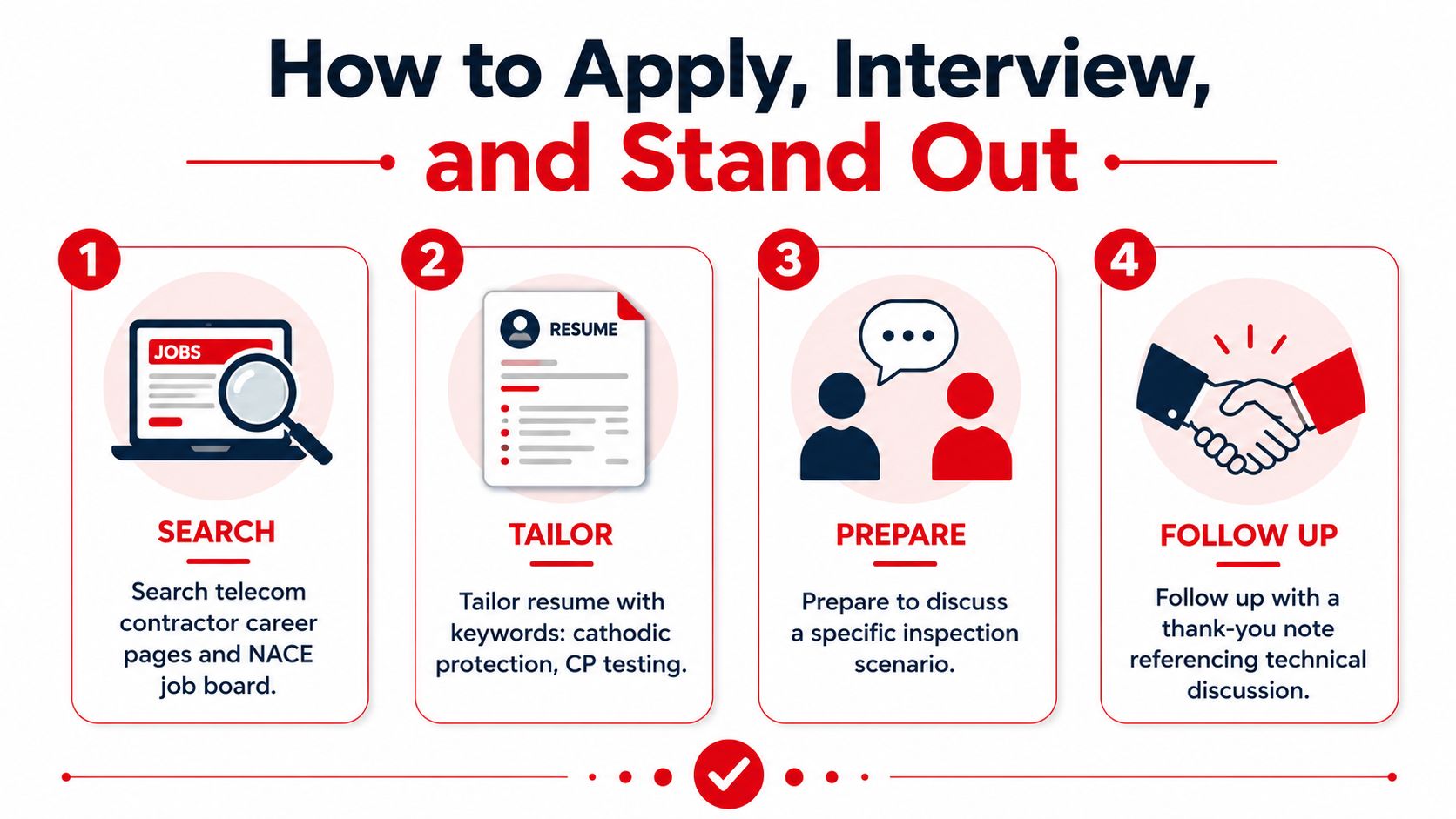
A strong application lets a hiring manager see the work behind the job title. Replace “performed corrosion inspections” with the asset checked, measurement taken, record completed, and action that followed. For telecom roles, connect your experience to tower steel, grounding, coatings, cabinets, and small cell equipment.
A telecom-focused resume can use bullets such as:
- Cathodic protection testing: Conducted CP field measurements, verified instrument setup, recorded site conditions, and escalated readings outside approved criteria.
- Grounding and bonding: Inspected tower grounding connections, bonds, exposed conductors, and related hardware for physical deterioration and documentation gaps.
- Coating condition: Evaluated exposed steel and coating defects, photographed locations, and prepared repair recommendations for review.
- Data quality: Completed formal test records with site identifiers, measurement results, defect descriptions, and corrective-action status.
- Safe field execution: Coordinated access, followed site safety procedures, protected equipment, and communicated hazards before testing.
Use bullets that match your actual experience. Interviewers will ask how you performed the work, what instruments or procedures you used, and how you handled an uncertain result. Credibility carries more weight than a long list of keywords.
Prepare for the technical conversation
An interviewer may describe a tower base with coating damage, a reading that differs from the previous record, or an apparently intact bond with an abnormal test result. Walk through your response in order:
- Confirm the asset, test point, equipment, and procedure.
- Check connections, instrument condition, and environmental factors.
- Repeat or cross-check the measurement when the result is unexpected.
- Record the finding without changing the data to fit an assumption.
- Escalate according to the applicable standard and site process.
The goal is sound judgment, not vocabulary alone. Explain what you would do, what the result does not yet prove, and which person or group should review it. A careful technician treats an unexpected reading like a warning light, something to verify before deciding on a repair.
As shown in the compensation data above, advanced skills and credentials can affect the roles available to you. Some postings value knowledge of API 510, 570, 571, 580, 581, and 653. Do not claim a qualification you have not earned. State whether you have studied the code, applied it under supervision, or used it independently.
For hiring managers, a concise posting can say:
Seeking a corrosion technician to perform field measurements, CP and grounding inspections, coating evaluations, defect documentation, and corrective-action follow-up across telecom sites. Candidates should demonstrate safe field execution, accurate electronic records, troubleshooting ability, and willingness to develop recognized corrosion credentials.
After the interview, send a brief thank-you note. Mention one technical issue discussed, identify the evidence you would bring to the role, and confirm your interest in field-based telecom infrastructure work.
Building a Long Term Career in Telecom Corrosion Control
A durable career starts with dependable field execution. Set up instruments correctly, protect measurement integrity, recognize unsafe conditions, and write records another technician can understand without calling for clarification. A clear report is part of the repair process, not paperwork added afterward.
Broaden your experience across tower steel, grounding systems, coatings, cabinets, and small cell equipment. Each asset presents different exposure, failure signs, and maintenance decisions. Your value grows when you can connect a physical condition to a measured result, explain what remains uncertain, and recommend a practical next action.
Advanced corrosion roles may combine inspection with API code familiarity, risk-based inspection, failure analysis, materials selection, root-cause investigation, positive material identification, and documentation. This progression can lead toward asset integrity, inspection coordination, audit support, and technical leadership. Describe your experience accurately, distinguishing study from supervised application and independent work.
A practical next sequence
- Document your baseline: List the equipment, coatings, grounding systems, and CP tasks you can perform without supervision.
- Choose the next credential: Select training that closes a real gap in your target telecom or industrial roles.
- Build code literacy: Learn how standards shape test frequency, acceptance criteria, records, and escalation.
- Collect proof of quality: Keep lawful, nonconfidential examples of reports, inspection checklists, and corrective-action narratives.
- Target the right employers: Review telecom construction jobs, then cross-reference postings that mention CP credentials, grounding inspection experience, and coating evaluation duties together.
Hiring managers need technicians who turn hidden conditions into documented maintenance decisions. That supports network reliability, worker safety, and defensible compliance practices. Telecom is a useful setting for corrosion expertise because carriers and tower companies maintain distributed outdoor assets, including tower steel, grounding paths, and small cell equipment.
Choose one credential or technical skill, revise your resume around measurable field responsibilities, and apply where tower, grounding, coating, and asset-integrity duties appear in the same role.
Southern Tier Resources delivers end-to-end engineering, construction, and maintenance for wireline and wireless networks, including small cells, macro towers, fiber infrastructure, and data center fit-outs. If you're looking for a telecom infrastructure partner that values safe field execution, detailed documentation, and dependable maintenance, visit Southern Tier Resources to discuss your project or career goals.